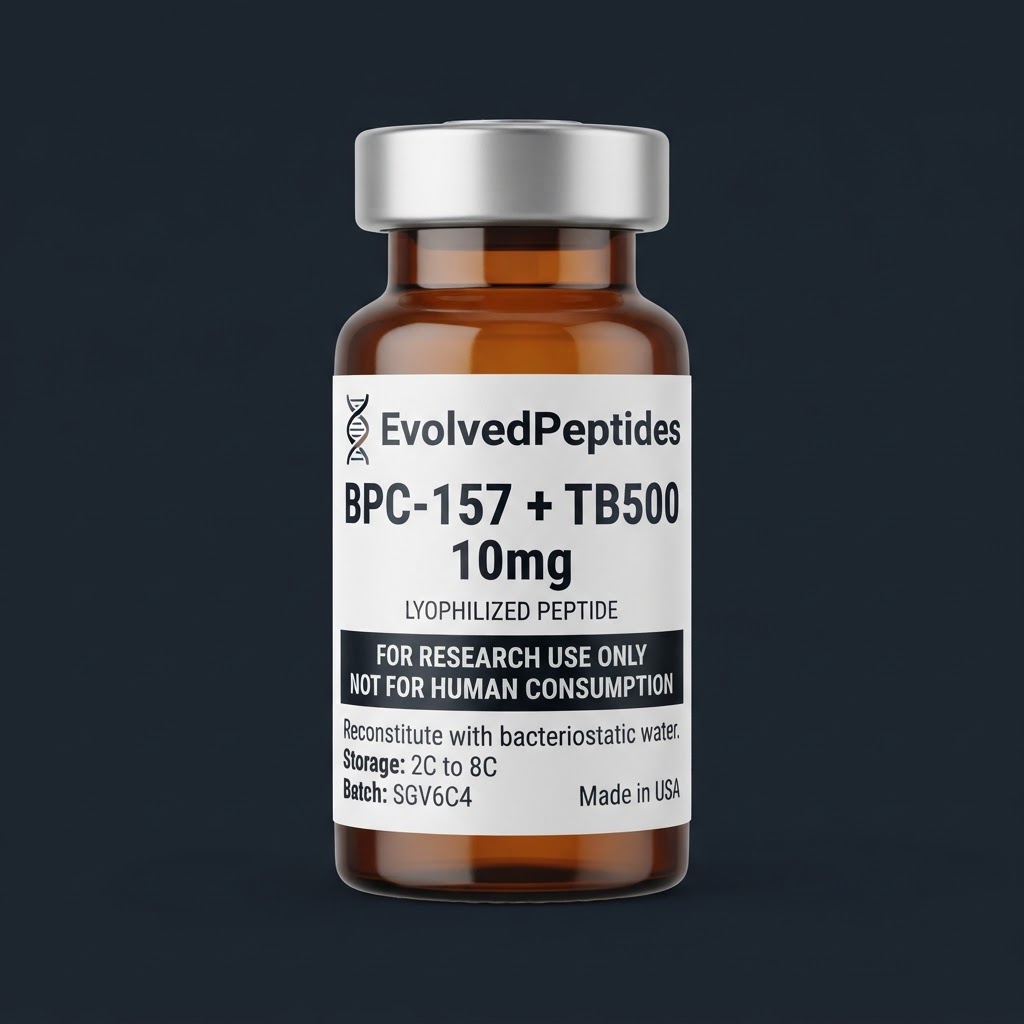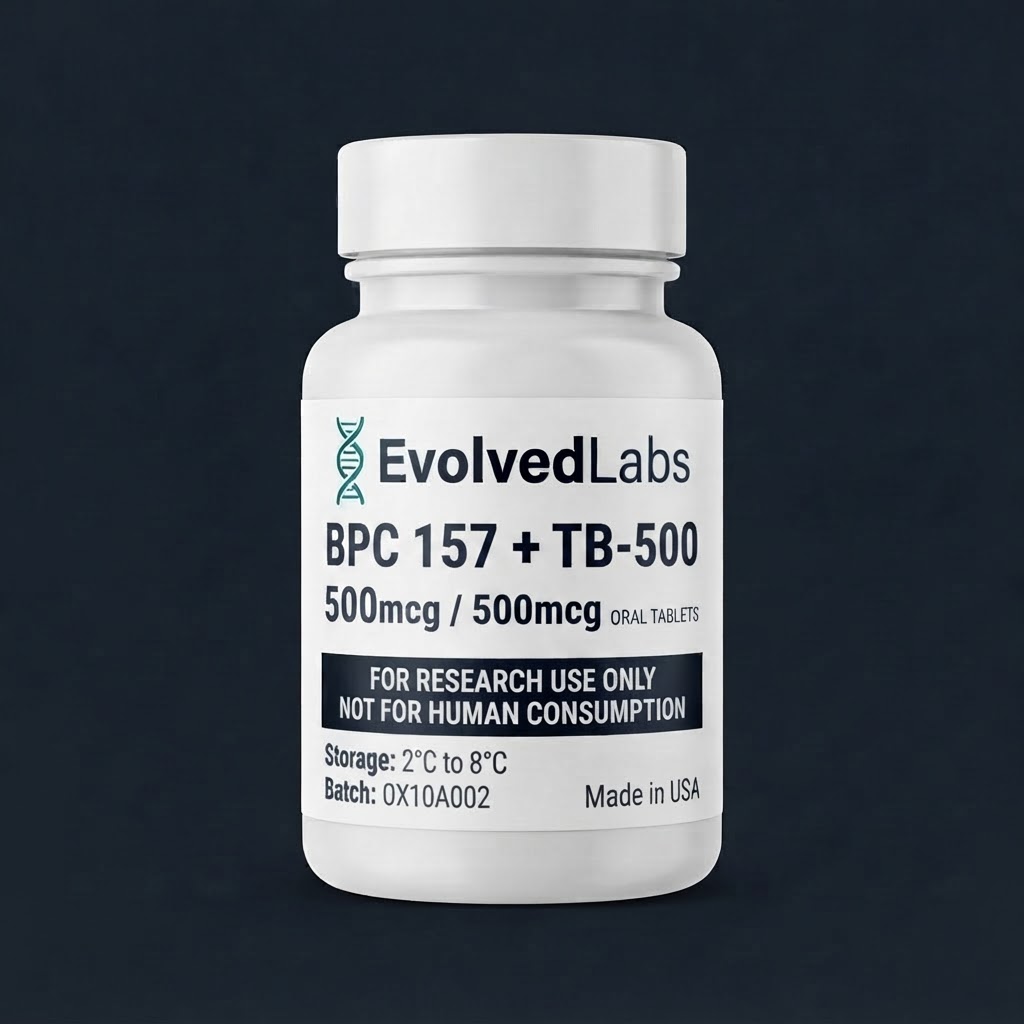
BPC 157 + TB-500 Oral Blend: Tissue Repair Research Without Injections
The BPC 157 + TB-500 oral blend combines two of the most researched healing peptides in a convenient tablet form. Explore the science behind oral delivery and tissue repair mechanisms.
The BPC 157 + TB-500 oral blend combines two of the most extensively researched tissue-repair peptides — BPC 157 (Body Protection Compound) and TB-500 (Thymosin Beta-4) — into a single oral tablet. This formulation provides a non-injectable alternative for researchers studying gastrointestinal healing, musculoskeletal recovery, and systemic tissue repair.
Understanding the Components
BPC 157 (Body Protection Compound) BPC 157 is a synthetic pentadecapeptide (15 amino acids) derived from human gastric juice. It has been extensively studied for: - Gastrointestinal mucosal healing and protection - Tendon, ligament, and muscle tissue repair - Angiogenesis and wound healing acceleration - Anti-inflammatory effects via multiple pathways - Neuroprotective properties
BPC 157 is notably stable in gastric acid, which makes it uniquely suited for oral administration — unlike most peptides that are degraded in the GI tract.
TB-500 (Thymosin Beta-4) TB-500 is a synthetic version of Thymosin Beta-4, a naturally occurring 43-amino acid peptide. Key research areas include: - Cellular migration and tissue remodeling - Angiogenesis and blood vessel formation - Actin sequestration and cell motility - Anti-inflammatory effects - Cardiac tissue repair
Why an Oral Blend?
Traditional BPC 157 and TB-500 research has relied on subcutaneous injection. The oral blend offers several research advantages:
1. BPC 157's Gastric Stability: BPC 157 was originally isolated from gastric juice and maintains stability in the harsh gastric environment. This makes it one of the few peptides that can be effectively delivered orally.
2. Gastrointestinal Targeting: Oral administration delivers BPC 157 directly to the GI mucosa — the primary site of its researched healing effects. This may offer advantages for GI-focused research.
3. Convenience and Compliance: Oral tablets eliminate the need for reconstitution, syringes, and subcutaneous injection, simplifying research protocols.
4. Synergistic Action: Combining BPC 157's GI and tissue-protective effects with TB-500's systemic tissue remodeling creates complementary pathways for recovery research.
Mechanism of Action
BPC 157 Mechanisms: - Upregulates growth factor expression (VEGF, VEGFR2, EGF) - Modulates nitric oxide (NO) synthesis and signaling - Promotes fibroblast proliferation and collagen synthesis - Enhances angiogenesis via VEGF pathway activation - Interacts with the dopamine and serotonin systems - Protects endothelial cells from oxidative stress
TB-500 Mechanisms: - Sequesters G-actin, promoting cell migration and motility - Upregulates actin-binding proteins for tissue remodeling - Promotes angiogenesis through multiple signaling pathways - Modulates inflammatory cytokine production - Enhances cellular differentiation in wound healing
Research Applications
1. Gastrointestinal Healing Research BPC 157 is most extensively studied for GI healing. Oral delivery may be particularly relevant for: - Gastric ulcer healing models - Inflammatory bowel disease (IBD) research - Gut barrier integrity studies - NSAID-induced GI damage models
2. Musculoskeletal Recovery Both peptides are researched for: - Tendon and ligament healing - Muscle strain recovery - Bone fracture healing - Joint tissue repair
3. Systemic Tissue Repair TB-500's systemic distribution supports: - Wound healing research - Cardiac tissue repair models - Corneal wound healing
Standard Research Protocols
Oral BPC 157 + TB-500 Blend: - Dose: 500mcg of each per tablet - Frequency: Once or twice daily - Route: Oral - Duration: 2–4 week cycles - Monitoring: Tissue repair markers, inflammatory cytokines, GI integrity markers
Bioavailability Considerations
While BPC 157 is stable in gastric acid, oral bioavailability of peptides is generally lower than injection. Research protocols may require higher oral doses to achieve equivalent systemic levels. However, for GI-targeted research, oral delivery may provide superior local concentrations.
Safety Profile
BPC 157 has demonstrated a wide safety margin in research, with no reported toxicity at many multiples of the research dose. TB-500 has similarly favorable safety data. The oral route eliminates injection-site reactions.
Quality Standards for Research
Research-grade BPC 157 + TB-500 oral tablets should be sourced from suppliers providing: - HPLC purity verification (≥98%) - Certificate of Analysis with batch-specific data - Accurate dosing per tablet (500mcg each) - Pharmaceutical-grade tablet manufacturing - Proper storage and handling documentation
Storage and Handling
Store at controlled room temperature (20–25°C), protected from light and moisture. Handle with standard laboratory safety protocols.
*This article is for research and informational purposes only. BPC 157 + TB-500 oral blend is sold for laboratory research purposes only and is not intended for human consumption. Not evaluated by the FDA.*