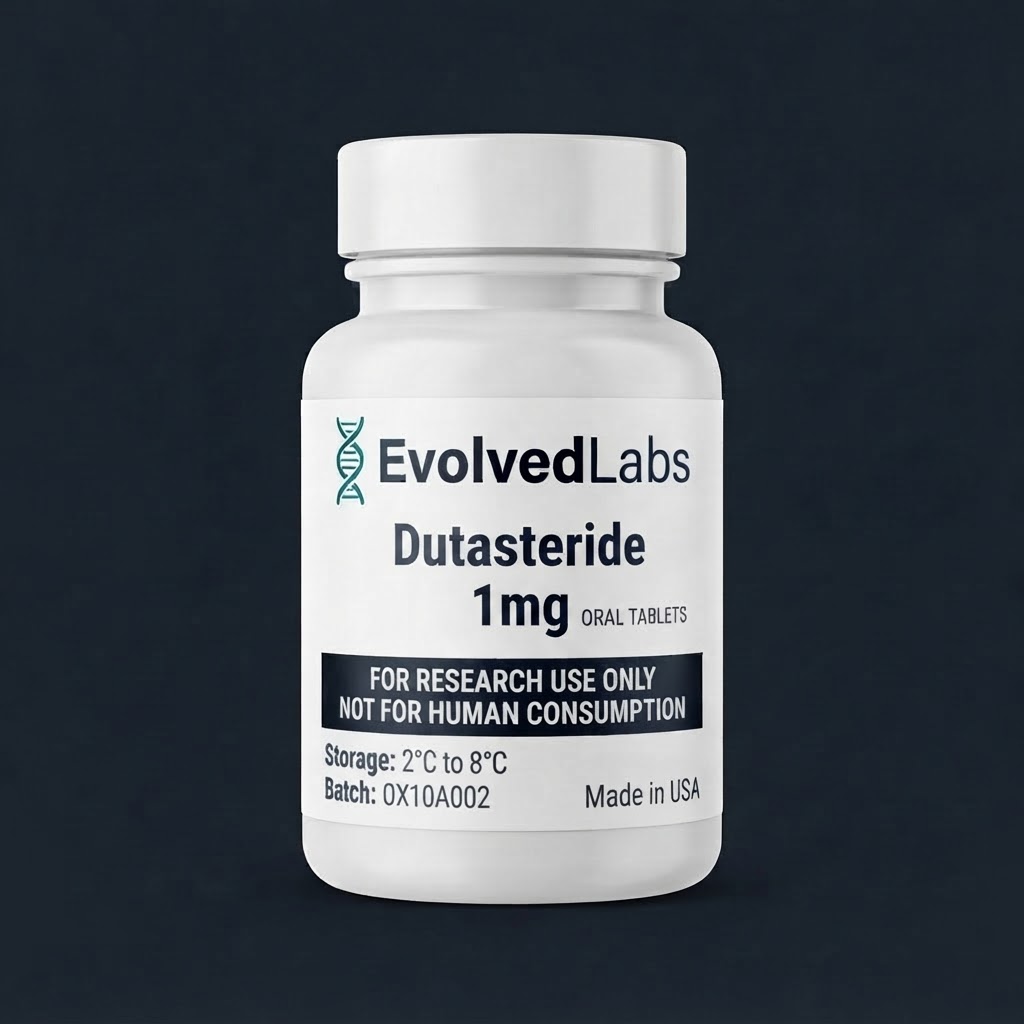
Dutasteride: Dual 5α-Reductase Inhibition for DHT Research
Dutasteride is a potent dual 5α-reductase inhibitor that suppresses DHT more completely than finasteride. Explore the pharmacology and research applications of this androgen-modulating compound.
Dutasteride is a potent dual 5α-reductase inhibitor that blocks both Type I and Type II isoforms of the enzyme, resulting in significantly more complete DHT (dihydrotestosterone) suppression than finasteride. It is extensively studied in androgen-dependent condition research.
What Is 5α-Reductase?
5α-Reductase is the enzyme responsible for converting testosterone into dihydrotestosterone (DHT) — a more potent androgen. Two primary isoforms exist:
| Isoform | Primary Locations | Function | |---|---|---| | Type I | Skin, liver, sebaceous glands | Systemic DHT production | | Type II | Prostate, hair follicles, genital skin | Localized DHT production |
Dutasteride vs. Finasteride
The key difference is isoform selectivity:
| Property | Dutasteride | Finasteride | |---|---|---| | Type I inhibition | Yes | No | | Type II inhibition | Yes | Yes | | DHT suppression | ~90%+ | ~70% | | Half-life | ~5 weeks | ~6 hours | | Potency | Higher | Lower |
Dutasteride's dual inhibition produces more complete DHT suppression, making it valuable for research requiring maximum androgen reduction.
Mechanism of Action
1. Enzyme Binding: Dutasteride binds to 5α-reductase enzymes (both Type I and Type II) 2. Competitive Inhibition: Blocks testosterone-to-DHT conversion 3. DHT Reduction: Reduces circulating and tissue DHT levels 4. Testosterone Preservation: Does not significantly lower testosterone itself 5. Sustained Effect: Long half-life (~5 weeks) provides prolonged inhibition
Pharmacokinetics
- Route: Oral - Half-life: ~5 weeks (extremely long) - Metabolism: Hepatic via CYP3A4 - Excretion: Primarily fecal - Steady State: ~6 months
The exceptionally long half-life means dutasteride remains in the body for months after discontinuation — an important consideration for research design.
Research Applications
1. Androgenetic Alopecia Research Dutasteride is studied for: - Male pattern hair loss treatment models - Comparison with finasteride efficacy - Hair follicle DHT levels and miniaturization - Hair count and density measurements
2. Prostate Research As a dual 5α-reductase inhibitor: - Benign prostatic hyperplasia (BPH) models - Prostate volume reduction studies - PSA level monitoring - Prostate cancer chemoprevention research
3. Androgen-Dependent Conditions - Hirsutism research - Acne and seborrhea models - Hormone-dependent dermatological conditions
Standard Research Protocols
Oral Dutasteride: - Dose: 0.5–1mg daily - Frequency: Once daily - Route: Oral - Duration: 6–12 months for full effects - Monitoring: DHT levels, testosterone, PSA, liver function, lipid panel
Safety Considerations in Research
Sexual Function: DHT reduction can affect: - Libido - Erectile function - Ejaculate volume These effects are typically reversible but may persist after discontinuation.
Hepatic Metabolism: Dutasteride is metabolized via CYP3A4. Research protocols monitor liver function, particularly in subjects with hepatic impairment.
Drug Interactions: CYP3A4 inhibitors can increase dutasteride exposure. Research protocols consider concurrent compound use.
Quality Standards for Research
Research-grade dutasteride should be sourced from suppliers providing: - HPLC purity verification (≥98%) - Certificate of Analysis with batch-specific data - Accurate dosing per tablet (1mg) - Pharmaceutical-grade tablet manufacturing - Proper storage and handling documentation
Storage and Handling
Store at controlled room temperature (20–25°C), protected from light and moisture. Handle with standard laboratory safety protocols.
*This article is for research and informational purposes only. Dutasteride is sold for laboratory research purposes only and is not intended for human consumption. Not evaluated by the FDA.*