Human Growth Hormone (HGH): The Complete Research Overview
Human Growth Hormone (somatropin) is one of the most studied peptide hormones in endocrinology and regenerative medicine. Explore its mechanisms, research applications, and role in metabolism, growth, and tissue repair research.
Human Growth Hormone (HGH), also known as somatotropin or somatropin in its recombinant form, is a 191-amino acid peptide hormone produced by the anterior pituitary gland. It is one of the most extensively studied hormones in endocrinology, metabolism, and regenerative medicine — with research spanning growth disorders, body composition, tissue repair, metabolic regulation, and age-related hormonal decline.
Structure and Biology
HGH is a single-chain polypeptide of 191 amino acids with a molecular weight of approximately 22 kDa. It is synthesized and stored in somatotroph cells of the anterior pituitary, which account for approximately 50% of the gland's cell mass — reflecting the hormone's fundamental biological importance.
Natural Secretion Patterns: GH is secreted in a pulsatile manner, with the largest pulses occurring during the first hours of deep (Stage 3/4) slow-wave sleep. Between pulses, GH levels are near-undetectable. This pulsatile pattern is critical for maintaining receptor sensitivity and is a key consideration in research design.
Regulation of Secretion: GH secretion is controlled by two hypothalamic hormones: - GHRH (Growth Hormone-Releasing Hormone): Stimulates GH release - Somatostatin (SST): Inhibits GH release
Additionally, ghrelin (the "hunger hormone") stimulates GH release through the GHS-R1a receptor — the basis for growth hormone secretagogue (GHS) research using compounds like Ipamorelin and CJC-1295.
Recombinant HGH (Somatropin)
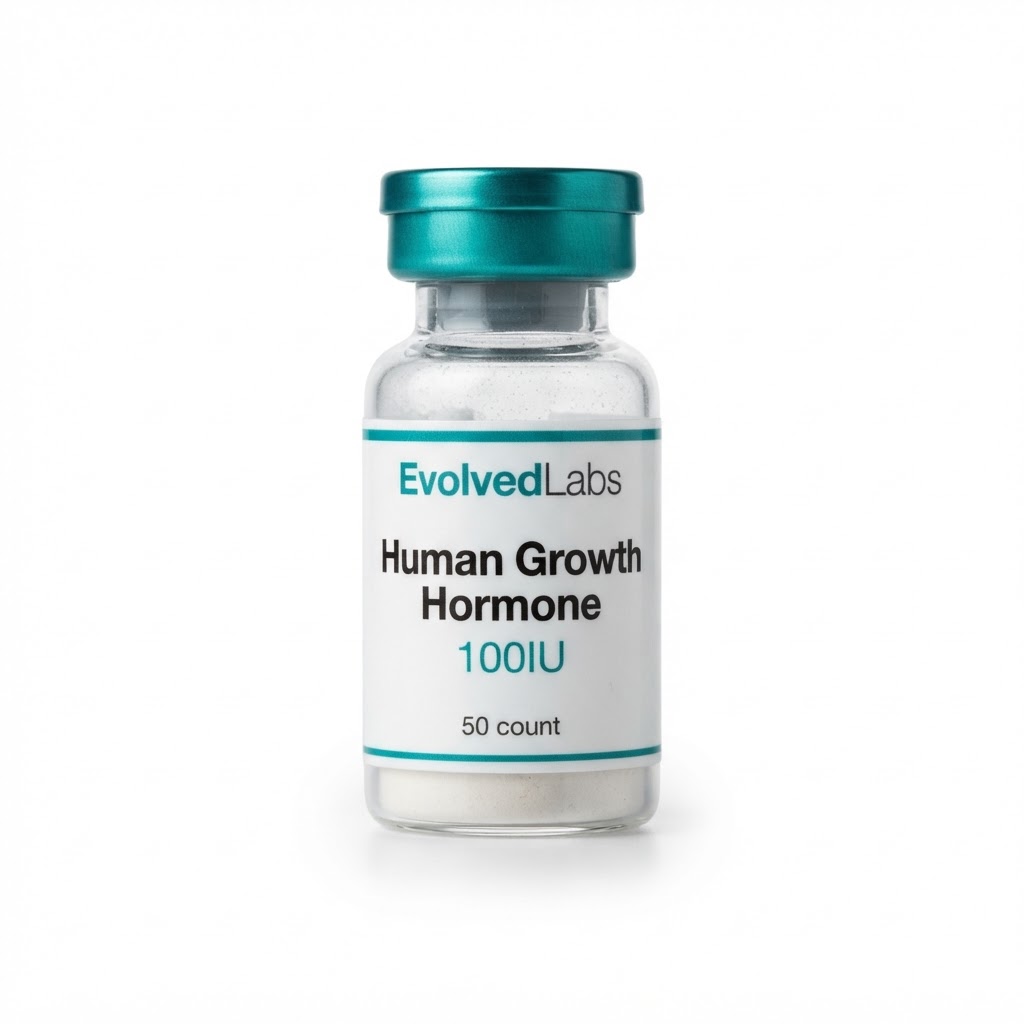
Research-grade HGH is produced via recombinant DNA technology — typically using E. coli or mammalian cell expression systems. Recombinant somatropin is identical in amino acid sequence to endogenous human GH (191 amino acids, 22 kDa), making it biologically equivalent.
Mechanism of Action
Direct GH Effects: GH binds to the growth hormone receptor (GHR) on target cell surfaces, activating the JAK2/STAT5 signaling pathway. Direct effects include: - Lipolysis stimulation (hormone-sensitive lipase activation in adipocytes) - Anti-insulin (diabetogenic) effects — reduced insulin sensitivity - Retention of sodium, potassium, and phosphorus - Skeletal growth stimulation (via direct effects on growth plates)
IGF-1 Mediated Effects: The majority of GH's anabolic effects are mediated through Insulin-like Growth Factor 1 (IGF-1), produced primarily in the liver in response to GH: - Protein synthesis stimulation - Cell proliferation and differentiation - Skeletal and somatic growth - Nitrogen retention (anabolic effect) - Cartilage formation
The GH → IGF-1 axis is the primary mechanism by which GH produces its well-known anabolic and growth-promoting effects.
Research Applications
1. Growth Hormone Deficiency (GHD) Research: HGH replacement research in GH-deficient models is the foundational clinical application. Research protocols study: - Linear growth restoration in pediatric GHD models - Body composition changes in adult GHD - Metabolic parameter normalization - Quality of life measures
2. Body Composition Research: GH's potent lipolytic and anabolic properties make it relevant for body composition studies: - Visceral fat reduction (preferential effect on abdominal adipose tissue) - Lean body mass increase - Total body water changes (extracellular water expansion) - Basal metabolic rate effects
3. Tissue Repair and Regeneration Research: GH and IGF-1 are fundamental to tissue healing and regeneration: - Collagen synthesis and connective tissue repair - Wound healing acceleration - Bone fracture healing - Cartilage regeneration research - Tendon and ligament repair studies
4. Metabolic Research: GH has complex metabolic effects that are extensively studied: - Lipid metabolism: enhanced lipolysis, reduced fat mass - Carbohydrate metabolism: reduced insulin sensitivity (counter-regulatory) - Protein metabolism: positive nitrogen balance, anabolic - Mineral metabolism: sodium/potassium/phosphorus retention
5. Age-Related GH Decline (Somatopause) Research: GH secretion declines approximately 14% per decade after age 30. By age 60, most adults produce only 25% of the GH they produced at age 20. This "somatopause" is associated with: - Increased visceral fat - Reduced lean body mass - Decreased bone mineral density - Reduced exercise capacity - Altered sleep architecture - Changes in skin thickness and quality
HGH research in aging populations studies reversal of these markers — though this is distinct from secretagogue research (CJC-1295, Ipamorelin, Sermorelin), which stimulates endogenous production rather than replacing exogenous hormone.
HGH vs. GH Secretagogues: An Important Research Distinction
| Approach | Mechanism | GH Pattern | Research Context | |---|---|---|---| | Recombinant HGH | Direct hormone replacement | Non-pulsatile (sustained elevation) | Replacement research, GHD models | | GHRH analogues (CJC-1295, Sermorelin) | Stimulate pituitary GH release | Pulsatile (physiological) | Anti-aging, body composition | | GHRPs (Ipamorelin) | Ghrelin receptor activation | Pulsatile (physiological) | GH optimization, sleep | | GHRH + GHRP stacks | Dual-pathway stimulation | Amplified pulsatile | Maximum GH optimization |
HGH provides direct, reliable GH elevation but does not preserve the natural pulsatile pattern. Secretagogues preserve physiological patterns but rely on functional pituitary capacity. Research design must account for these differences.
Standard Research Protocols
GHD Replacement Model: - Dose: 0.15–0.3 mg/week per kg body weight (divided into daily administrations) - Route: Subcutaneous injection - Timing: Evening (to approximate natural nocturnal GH peak) - Monitoring: IGF-1 levels (primary biomarker), body composition, metabolic markers - Duration: Continuous in replacement research
Adult Body Composition Research: - Dose: 0.5–2 IU daily (IU = International Unit; 1 IU ≈ 0.33mg) - Duration: 3–6 months minimum for body composition assessment - Assessments: DEXA, IGF-1, fasting glucose/insulin, lipid panel
Anti-Aging/Somatopause Research: - Dose: 0.5–1 IU daily (conservative dosing in aging research) - Duration: 6+ months - Monitoring: IGF-1 (maintained within physiological range), body composition, bone density, sleep quality
Safety Considerations in Research
Fluid Retention: GH causes sodium and water retention — peripheral edema is the most commonly reported effect. Research protocols monitor for fluid retention, particularly in the initial weeks.
Insulin Sensitivity: GH has anti-insulin (diabetogenic) effects. Fasting glucose and insulin, along with HOMA-IR, are standard monitoring parameters. Research subjects with metabolic risk factors require additional monitoring.
IGF-1 Monitoring: IGF-1 is the primary biomarker for GH dosing — levels are maintained within age-adjusted physiological ranges. Excessively elevated IGF-1 is associated with greater side effect risk.
Joint and Nerve Effects: Carpal tunnel syndrome-like symptoms (tingling, numbness in extremities) can occur — typically dose-dependent and reversible with dose reduction.
Acromegaly Risk: Chronic GH excess (as in acromegaly) produces characteristic changes. Research protocols maintain IGF-1 within physiological ranges to avoid these effects.
Storage and Handling
Recombinant HGH requires specific handling: - Lyophilized powder: Store at 2–8°C (refrigerated); protect from light - Reconstituted solution: Store at 2–8°C; use within 14–28 days (depending on manufacturer specifications) - Never freeze reconstituted HGH — ice crystals degrade the protein - Reconstitution: Use bacteriostatic water; inject slowly along vial wall; swirl gently (never shake — mechanical stress denatures the protein)
Quality Standards for Research
Research-grade HGH should be sourced from suppliers providing: - HPLC purity verification - Certificate of Analysis with batch-specific data - Biological potency testing (IU verification) - Sterility and endotoxin testing - Proper cold-chain storage and shipping documentation - Accurate labeling of IU content and lot number
Conclusion
Human Growth Hormone remains one of the most important compounds in endocrinology and regenerative medicine research. Its broad biological activity — spanning metabolism, body composition, tissue repair, and growth — makes it relevant across an exceptionally wide range of research contexts. Whether studied directly as recombinant somatropin or indirectly via secretagogue research, the GH/IGF-1 axis continues to be one of the most productive areas of endocrine and metabolic research.
*This article is for research and informational purposes only. Human Growth Hormone is sold for laboratory research purposes only and is not intended for human consumption. Not evaluated by the FDA.*