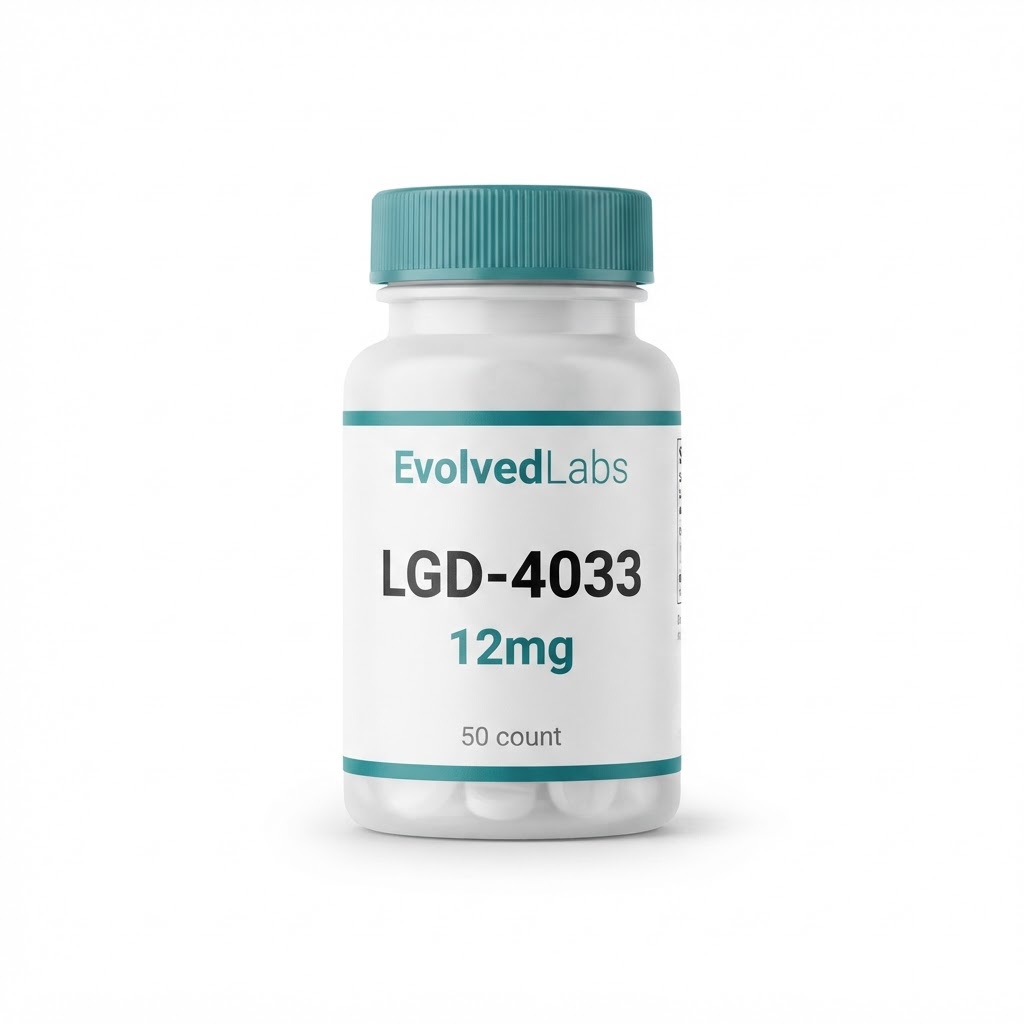
LGD-4033 (Ligandrol): SARM Research and Tissue-Selective Anabolic Activity
LGD-4033 is one of the most studied selective androgen receptor modulators (SARMs) — offering tissue-selective anabolic effects with reduced androgenic activity. A comprehensive overview of its research profile.
LGD-4033 (commonly known as Ligandrol) is a selective androgen receptor modulator (SARM) — a class of compounds designed to provide the anabolic benefits of androgens (muscle growth, bone density) while minimizing androgenic effects in non-target tissues (prostate, skin, hair). LGD-4033 is one of the most extensively studied SARMs in clinical research.
What Are SARMs?
Selective Androgen Receptor Modulators (SARMs) represent a pharmacological approach to tissue-selective androgen therapy. Unlike traditional anabolic-androgenic steroids (AAS), which activate androgen receptors throughout the body, SARMs are designed to:
- Preferentially activate AR in muscle and bone (anabolic target tissues) - Minimize activation in prostate, sebaceous glands, and hair follicles (androgenic non-target tissues) - Avoid aromatization (conversion to estrogen) — unlike testosterone - Avoid 5-alpha reduction to more potent androgens in non-target tissue
This tissue selectivity is achieved through: 1. Conformational receptor binding: SARMs induce a specific AR conformation that recruits different co-regulator proteins in different tissues 2. Tissue-specific co-regulator expression: Different tissues express different AR co-activators/co-repressors 3. Pharmacokinetic tissue distribution: Some SARMs achieve higher concentrations in muscle/bone than in prostate
LGD-4033 Structure and Properties
LGD-4033 is a non-steroidal, orally bioavailable SARM:
- Route: Oral (capsule/tablet) - Half-life: Approximately 24–36 hours (enables once-daily dosing) - Bioavailability: High oral bioavailability (non-17-alpha-alkylated — lower hepatotoxicity risk than oral AAS) - AR binding affinity: High — potent at relatively low doses
Mechanism of Action
LGD-4033 binds the androgen receptor with high affinity and selectivity:
1. AR binding: LGD-4033 binds cytosolic androgen receptors, particularly in muscle and bone tissue 2. Nuclear translocation: The compound-receptor complex translocates to the nucleus 3. Gene transcription modulation: Alters expression of anabolic genes (protein synthesis, nitrogen retention) 4. Tissue-selective effects: Produces anabolic effects preferentially in skeletal muscle and bone
The key distinction from traditional AAS: LGD-4033 produces a different AR conformation that results in tissue-selective co-regulator recruitment — anabolic effects in muscle/bone, minimal androgenic effects in prostate/skin/hair.
Research Applications
1. Muscle Wasting and Sarcopenia The primary research application for LGD-4033: - Age-related muscle loss (sarcopenia) - Cancer cachexia - Chronic disease-associated muscle wasting - Disuse atrophy (immobilization, bed rest)
Phase 1 clinical trials demonstrated: - Dose-dependent increases in lean body mass - Significant improvements in strength measures - Favorable safety profile at research doses - Effects observed within 3 weeks of administration
2. Bone Density Research Androgens are important for bone health. LGD-4033's bone-selective activity makes it relevant for: - Osteoporosis research - Fracture healing - Age-related bone loss - Glucocorticoid-induced bone loss
3. Rehabilitation Research The anabolic properties and oral administration make LGD-4033 relevant for: - Post-surgical recovery - Injury rehabilitation - Muscle reconditioning after immobilization
4. Body Composition Research - Lean mass increase - Fat mass reduction (indirectly, via improved metabolic function) - Strength improvements
LGD-4033 vs. Traditional AAS: The Selectivity Advantage
| Property | LGD-4033 | Testosterone | Oxandrolone | |---|---|---|---| | Route | Oral | Injectable (or oral) | Oral | | AR selectivity | Muscle/bone selective | Non-selective | Moderately selective | | Aromatization | No | Yes | No | | 5-alpha reduction | No (not a substrate) | Yes | No | | Prostate effects | Minimal | Yes | Minimal | | Hepatotoxicity | Low (non-alkylated) | None (injectable) | Low-moderate (alkylated) | | HPG suppression | Moderate | Significant | Significant |
Standard Research Protocols
Phase 1 Clinical Trial Protocol (Reference): - Dose: 0.1mg, 0.3mg, 1.0mg daily - Duration: 21 days - Route: Oral - Assessment: Lean body mass (DEXA), strength, pharmacokinetics, safety
Body Composition Research: - Dose: 1–10mg daily (varies by research design) - Duration: 4–8 weeks - Monitoring: DEXA, hormone panels, liver function, lipid panel
Safety Considerations in Research
HPG Axis Suppression: LGD-4033 suppresses endogenous testosterone production via negative feedback on the hypothalamic-pituitary-gonadal axis. Research protocols monitor: - Total testosterone - Free testosterone - LH and FSH - Recovery dynamics after discontinuation
Suppression is generally considered moderate and reversible, but depends on dose and duration.
Lipid Effects: Like many androgenic compounds, LGD-4033 may affect lipid profiles: - Potential HDL reduction - Potential LDL changes - Research protocols monitor fasting lipid panels
Liver Function: While LGD-4033 is non-17-alpha-alkylated (lower hepatotoxicity risk than oral AAS), liver function monitoring is standard practice: - ALT, AST, GGT, bilirubin - Research suggests minimal hepatotoxicity at standard doses
Absence of Estrogenic Effects: LGD-4033 does not aromatize: - No gynecomastia risk - No water retention from estrogen - No estrogen-mediated lipid changes
This is a significant advantage in research where estrogenic effects are undesirable.
Absence of 5-Alpha Reduction: LGD-4033 is not a substrate for 5-alpha-reductase: - No conversion to more potent androgens - Minimal effects on skin, hair, prostate - Reduced androgenic side effect profile
Quality Standards for Research
Research-grade LGD-4033 should be sourced from suppliers providing: - HPLC purity verification (≥98%) - Certificate of Analysis with batch-specific data - Accurate dosing per capsule/tablet - Proper storage and handling documentation
*This article is for research and informational purposes only. LGD-4033 is sold for laboratory research purposes only and is not intended for human consumption. Not evaluated by the FDA.*