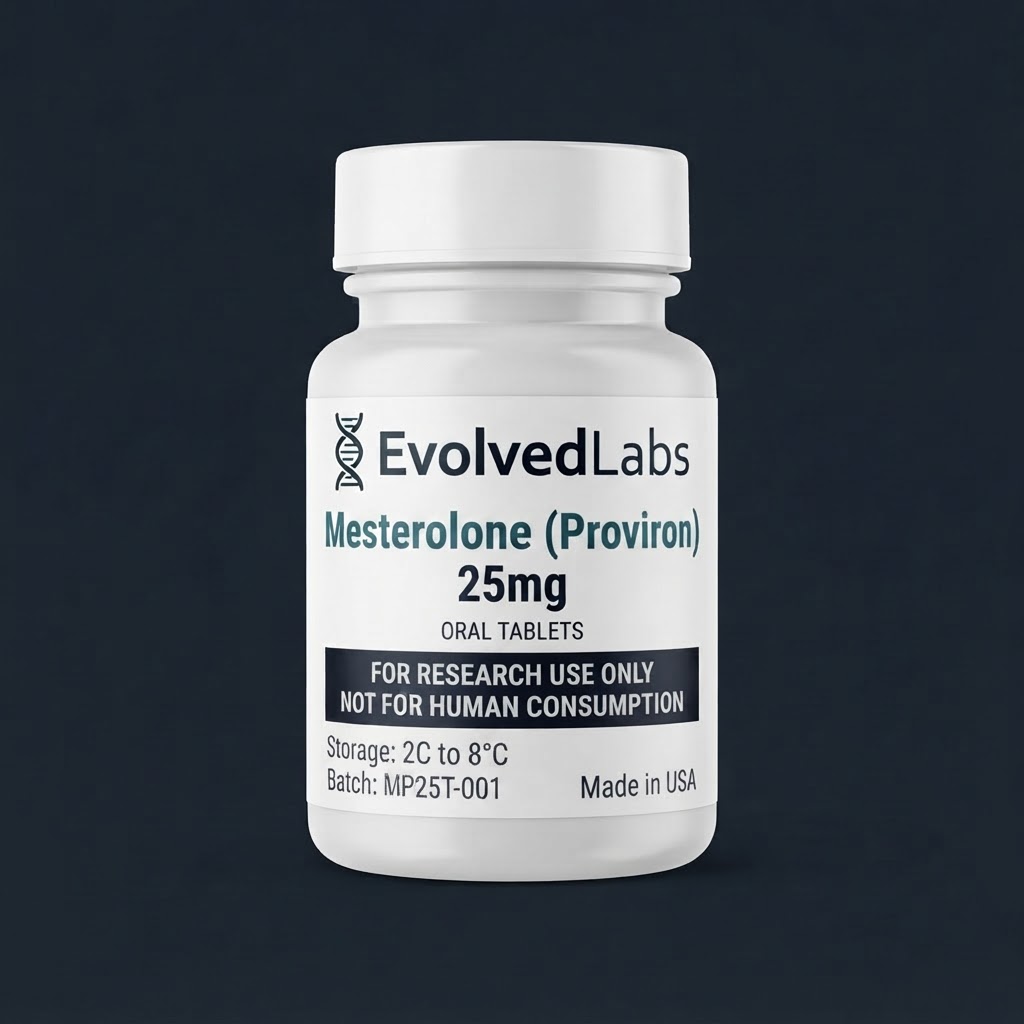
Mesterolone (Proviron): DHT-Derived Oral Androgen Research
Mesterolone, known as Proviron, is a unique DHT-derived oral androgen with weak anabolic but strong androgenic activity. Explore its mechanisms, non-aromatizing properties, and research applications.
Mesterolone (commonly known by its brand name Proviron) is a synthetic oral anabolic-androgenic steroid (AAS) derived from dihydrotestosterone (DHT). Unlike most oral AAS, mesterolone is characterized by very weak anabolic activity but significant androgenic activity — making it a unique compound in androgen research with distinct research applications.
Chemical Structure and DHT Derivation
Mesterolone is a 17-alpha-alkylated derivative of dihydrotestosterone (DHT). The key structural features include:
- 17-alpha alkylation: Allows oral bioavailability by resisting hepatic first-pass metabolism - 1-methyl group: This modification is responsible for mesterolone's weak anabolic activity — it reduces the compound's ability to promote muscle growth while maintaining androgenic activity - DHT base structure: Cannot be aromatized (converted to estrogen), eliminating estrogenic side effects
The 1-methyl group makes mesterolone pharmacologically unique — it is one of the only AAS where anabolic activity is deliberately reduced relative to androgenic activity.
Pharmacokinetics
- Route: Oral (tablet) - Half-life: Approximately 12 hours - Bioavailability: Moderate (~3%) — relatively low oral bioavailability compared to other oral AAS - Metabolism: Primarily hepatic; reduced and inactivated in muscle tissue - Duration of action: Requires 2–3x daily dosing in research protocols
A unique pharmacokinetic feature: mesterolone is rapidly reduced and inactivated in skeletal muscle tissue. This is a key reason for its weak anabolic effects — the compound is deactivated in the very tissue where anabolic effects would typically occur.
Mechanism of Action
Mesterolone acts through the androgen receptor (AR), but its tissue-selective inactivation produces a unique profile:
1. AR binding: Mesterolone binds androgen receptors, particularly in non-muscle tissues 2. Muscle inactivation: Rapidly reduced to inactive metabolites in skeletal muscle 3. Androgenic effects preserved: Active in tissues without 3α-HSD (the enzyme that inactivates it in muscle) 4. SHBG binding: Mesterolone binds sex hormone-binding globulin (SHBG) with high affinity, potentially increasing free testosterone 5. Aromatase inhibition: Mild aromatase inhibition effects at higher doses
The DHT-derived structure means mesterolone cannot be aromatized — and it may actually reduce estrogen production through mild aromatase inhibition.
Research Applications
1. Androgen Deficiency Research
Mesterolone has been studied for androgen deficiency: - Mild androgen replacement in hypogonadal research models - Particularly studied in older populations - Lower hepatotoxicity risk than other oral AAS at equivalent doses - Research monitors testosterone levels, androgen markers
2. SHBG Modulation Research
One of mesterolone's most researched properties: - Binds SHBG with high affinity - May displace bound testosterone, increasing free testosterone - Studied in conditions of elevated SHBG - Research monitors total vs. free testosterone ratios
3. Sperm Quality and Male Fertility
Mesterolone has been extensively studied in male fertility research: - May improve sperm parameters in some research models - Unlike testosterone, does not consistently suppress spermatogenesis at research doses - Studied in idiopathic male infertility - Research monitors semen analysis parameters
4. Estrogen Management in Hormone Research
Mesterolone's anti-estrogenic properties make it relevant for: - Mild estrogen management in androgen research protocols - Alternative to SERMs/AIs for mild estrogen control - Non-aromatizing androgen support - Research monitors estradiol levels
5. Body Composition Research
Though weak anabolic activity limits muscle-building effects: - Enhanced muscle hardness and definition (non-aromatizing, no water retention) - Improved androgen-to-estrogen ratio - Studied in combination with other compounds - Research monitors body composition (DEXA)
Mesterolone vs. Other DHT-Derived AAS
| Property | Mesterolone | Drostanolone | Stanozolol | Oxandrolone | |---|---|---|---|---| | Route | Oral | Injectable | Oral/Injectable | Oral | | Anabolic activity | Weak | Moderate | Moderate | High | | Androgenic activity | Strong | Moderate | Low | Low | | SHBG binding | High | Low | Moderate | Low | | Aromatase inhibition | Mild | No | No | No | | Muscle inactivation | Yes (rapid) | No | No | No | | Research context | Androgen support, SHBG | Anti-estrogenic, hardness | Cutting, anabolic | Anabolic, mild |
Standard Research Protocols
Androgen Support Research: - Dose: 25–50mg daily (divided 2–3x daily) - Duration: 6–12 weeks - Route: Oral - Monitoring: Total/free testosterone, SHBG, estradiol, liver function, lipid panel
Fertility Research: - Dose: 25–50mg daily - Duration: 3–6 months in long-term studies - Monitoring: Semen analysis (count, motility, morphology), hormone panels
SHBG Modulation Research: - Dose: 25–50mg daily - Duration: 4–8 weeks - Monitoring: SHBG, total testosterone, free testosterone, calculated free androgen index
Safety Considerations in Research
Hepatotoxicity: As a 17-alpha-alkylated compound, mesterolone carries potential for hepatotoxicity. However, research suggests it is among the least hepatotoxic of the oral AAS — with liver enzyme elevations typically mild and reversible. Research protocols monitor liver function (ALT, AST, GGT, bilirubin).
Lipid Effects: Like most AAS, mesterolone affects lipid profiles: - Reductions in HDL cholesterol - Potential increases in LDL cholesterol - Research protocols monitor fasting lipid panels
Endocrine Effects: Exogenous mesterolone suppresses endogenous testosterone production via HPG axis negative feedback — though suppression may be less pronounced than with other AAS due to its weak anabolic activity. Research protocols monitor LH, FSH, total/free testosterone.
Prostate Considerations: As a DHT-derived androgen with significant androgenic activity: - Research protocols monitor prostate-specific antigen (PSA) - Prostate examination in long-term research - Particularly relevant in older research subjects
Absence of Estrogenic Effects: Since mesterolone cannot aromatize and may mildly inhibit aromatase: - No gynecomastia risk - No water retention from estrogen - No estrogen-mediated lipid changes - May actually reduce circulating estrogen
Quality Standards for Research
Research-grade mesterolone should be sourced from suppliers providing: - HPLC purity verification (≥98%) - Certificate of Analysis with batch-specific data - Accurate dosing per tablet - Proper storage and handling documentation
Storage and Handling
Research-grade mesterolone tablets should be stored at controlled room temperature (20–25°C), protected from light and moisture, and handled with standard laboratory safety protocols.
*This article is for research and informational purposes only. Mesterolone is sold for laboratory research purposes only and is not intended for human consumption. Not evaluated by the FDA.*