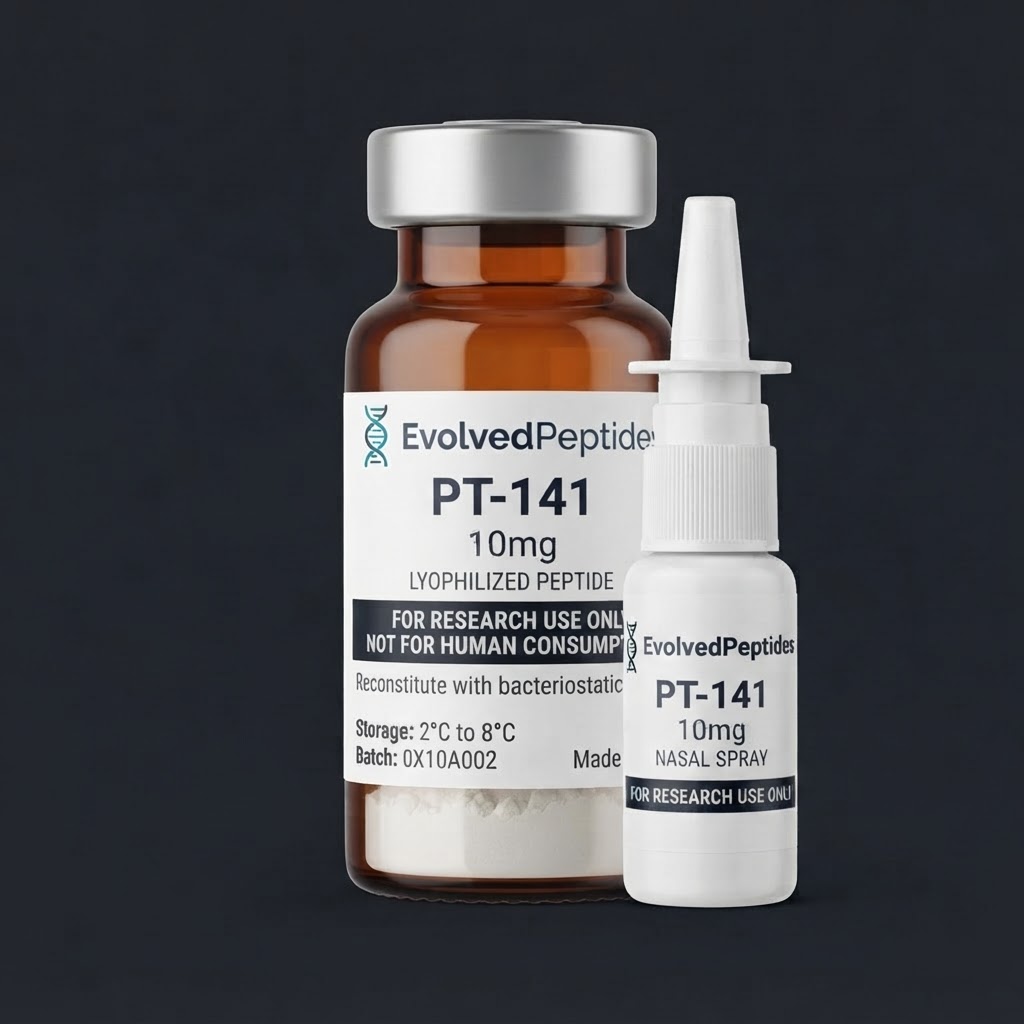
PT-141 (Bremelanotide): The Science of Melanocortin & Sexual Health Research
PT-141 works through the melanocortin system — a fundamentally different pathway from most sexual health compounds. Here's what the research reveals about this unique peptide.
PT-141, also known as Bremelanotide, is a cyclic heptapeptide melanocortin receptor agonist that was discovered as a metabolite of Melanotan II. It represents one of the most significant advances in the research of sexual health physiology — it's one of the only compounds studied that acts centrally (through the brain and CNS) rather than through the peripheral vascular system.
The Melanocortin System: Background
Melanocortin receptors (MC1R–MC5R) are G protein-coupled receptors found throughout the body: - MC1R: pigmentation (skin and hair) - MC2R: adrenal function (ACTH receptor) - MC3R: energy homeostasis, inflammation, and reward - MC4R: appetite regulation, energy expenditure, sexual behavior - MC5R: exocrine gland function
PT-141 primarily activates MC3R and MC4R — specifically in the hypothalamus, where sexual arousal and behavior are neurologically regulated.
The Vascular vs. CNS Distinction
Most traditional approaches to sexual dysfunction research focused on vascular mechanisms — increasing blood flow to genital tissue. This approach: - Requires physical arousal to work - Primarily affects peripheral vasculature - Has limited relevance to libido, desire, or psychological aspects of arousal
PT-141 works entirely differently: - Acts in the hypothalamus before any vascular changes occur - Activates melanocortin pathways that regulate sexual motivation and desire - Works regardless of vascular status - Relevant to both spontaneous and situational sexual response
This central mechanism explains why PT-141 shows efficacy in populations where vascular-targeted compounds have limited success.
From Melanotan II to PT-141: The Discovery Story
Researchers studying Melanotan II for tanning research in the 1990s at the University of Arizona noted unexpected pro-erectile effects in male subjects during early trials. A researcher famously experienced spontaneous, unexpected erections and reported it as an adverse finding. This discovery led to the isolation of PT-141 as a compound optimized for the sexual health pathway while minimizing the tanning/pigmentation effects of MT-2.
Research in Male Subjects
Multiple controlled studies of PT-141 in men with erectile dysfunction found: - Dose-dependent improvements in erectile function - Efficacy in men who did not respond to PDE-5 inhibitors (vascular-mechanism drugs) - Effects noted regardless of whether subjects had vascular, neurogenic, or psychogenic dysfunction - Onset of effects at 45–60 minutes, duration of 6–12 hours in research - Particular interest in psychogenic ED where physical arousal mechanisms are intact but desire/response is impaired
Research in Female Subjects
PT-141 is one of the very few compounds studied for female sexual dysfunction — a historically underresearched area. Findings include: - Improved genital arousal (measured by vaginal blood flow in controlled studies) - Increased sexual desire scores - Improved satisfaction ratings in women with hypoactive sexual desire disorder (HSDD) - FDA review led to the approval of Vyleesi (bremelanotide injectable) for HSDD in premenopausal women — making PT-141 one of the only research peptides with a directly derived FDA-approved application
Difference Between PT-141 and Melanotan 2
| Feature | Melanotan 2 | PT-141 | |---|---|---| | Receptor targets | MC1R, MC3R, MC4R | Primarily MC3R, MC4R | | Tanning effect | Significant | Minimal | | Libido effect | Yes | Yes (primary effect) | | Appetite suppression | Yes (MC4R) | Mild | | Route | Subcutaneous | Subcutaneous or intranasal | | Duration | Longer lasting | 6–12 hours |
MT-2's broader receptor profile means more effects across more systems — PT-141 was refined to isolate the sexual health mechanism.
Research Protocol
- Dose: 1–2mg subcutaneous (research commonly starts at 0.5–1mg to assess response) - Timing: 30–60 minutes before the research window - Frequency: As needed; not intended for daily use in research protocols - Route: Subcutaneous injection; some research with intranasal administration
Side Effects Noted in Research
- Nausea – Most common (30–40% of subjects at 1.75mg in trials); typically transient (1–2 hours) - Flushing – Face and neck warmth - Headache – Mild, transient - Blood pressure – Transient increases noted; relevant consideration for cardiovascular research subjects - Yawning – Commonly noted at onset, attributed to hypothalamic MC activation
Reducing dose to 1mg significantly reduces nausea incidence while preserving efficacy in research.
*This article is for research and informational purposes only.*