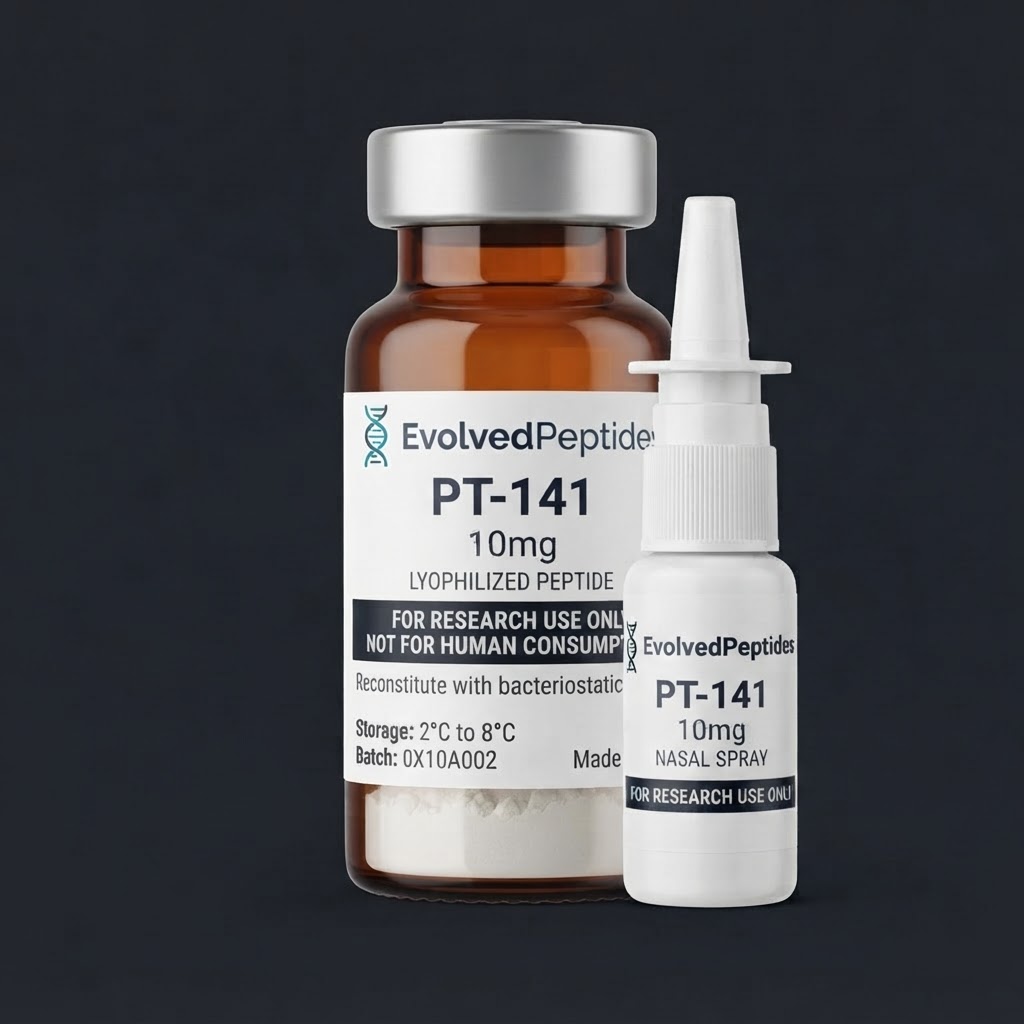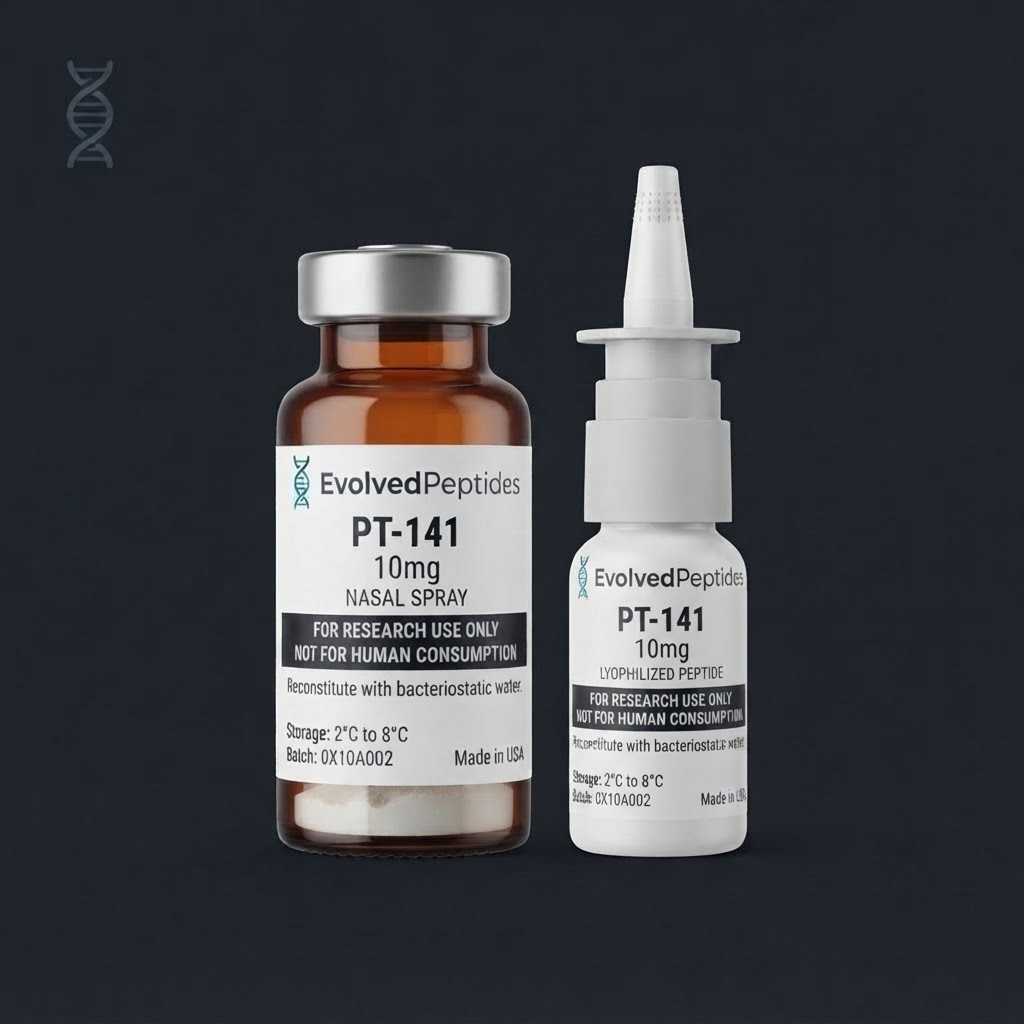
PT-141 Nasal Spray: Intranasal Bremelanotide Research Overview
PT-141 (bremelanotide) nasal spray delivers the melanocortin receptor agonist by intranasal route — the same administration route used in the compound's clinical research. Explore intranasal delivery science and research protocols.
PT-141 (bremelanotide) is a cyclic heptapeptide melanocortin receptor agonist, studied in research models for its effects on central melanocortin pathways. While PT-141 is often discussed alongside the tanning peptide Melanotan II — it was originally derived from that research lineage — PT-141 itself lacks significant melanogenic activity and is instead studied for central melanocortin-4 receptor (MC4R) mechanisms. The nasal spray format is of particular research interest because intranasal delivery was the route used in early clinical investigations of the compound.
Chemical Structure
PT-141 is a ring structure of seven amino acids (Ac-Nle-cyclo[Asp-His-D-Phe-Arg-Trp-Lys]-NH2) derived from the alpha-melanocyte-stimulating hormone (alpha-MSH) sequence. Key properties:
- Cyclic structure: Improves metabolic stability relative to linear melanocortin peptides - MC4R selectivity: Activates melanocortin receptors MC3R and MC4R, which are expressed in the central nervous system - Central activity: Because its target receptors sit in the hypothalamus and limbic system, research interest focuses on centrally mediated behaviors
Why Intranasal Delivery?
Intranasal administration is a well-studied route for small peptides in neuroscience research:
1. Nose-to-brain transport: The olfactory and trigeminal pathways can transport peptides across the blood-brain barrier-restricted route directly to the CNS 2. Rapid onset: Intranasal peptides typically reach systemic and central compartments within minutes 3. Avoids GI degradation: No exposure to gastric and intestinal enzymes 4. Clinical precedent: Early-phase clinical research on PT-141 explored intranasal administration before subcutaneous dosing became the primary clinical route
For research models, intranasal PT-181 allows study of central melanocortin effects without injection variables.
Mechanism of Action
1. MC4R activation: PT-141 binds melanocortin-4 receptors in the hypothalamus and other CNS nuclei 2. Central pathway modulation: MC4R signaling is studied for its role in arousal-related neurocircuitry 3. No direct vascular mechanism: Unlike PDE5 inhibitors, which act peripherally on vascular nitric oxide signaling, melanocortin agonists act centrally — a mechanistic distinction that has driven comparative research
Research Protocol Reference
| Parameter | Typical Research Reference | |---|---| | Dose | 1-2 mg per administration (intranasal) | | Frequency | As needed; max 2-3 administrations per week | | Route | Intranasal | | Onset | Minutes-to-an-hour class onset in pharmacokinetic studies | | Monitoring | Behavioral endpoints, blood pressure |
Research protocols commonly reference 1-2 mg intranasal doses, with as-needed administration capped at 2-3 uses per week. Published research notes blood pressure monitoring because of transient cardiovascular observations at higher doses.
PT-141 Nasal Spray vs. Subcutaneous PT-141
| Property | Nasal spray | Subcutaneous | |---|---|---| | Onset | Faster (minutes) | ~30-60 min | | Bioavailability | Lower, variable | Higher | | Administration | No needles | Injection | | Dose referenced | 1-2 mg | 1-2 mg | | Research utility | CNS-focused studies, convenience | Maximum systemic exposure |
Handling and Quality
Research-grade PT-141 nasal spray formulations should be stored per label, protected from heat and light, with verified: - HPLC purity verification (≥98%) - Certificate of Analysis with batch-specific data - Verified peptide content per spray
*This article is for research and informational purposes only. PT-141 is sold for laboratory research purposes only and is not intended for human consumption. Not evaluated by the FDA.*