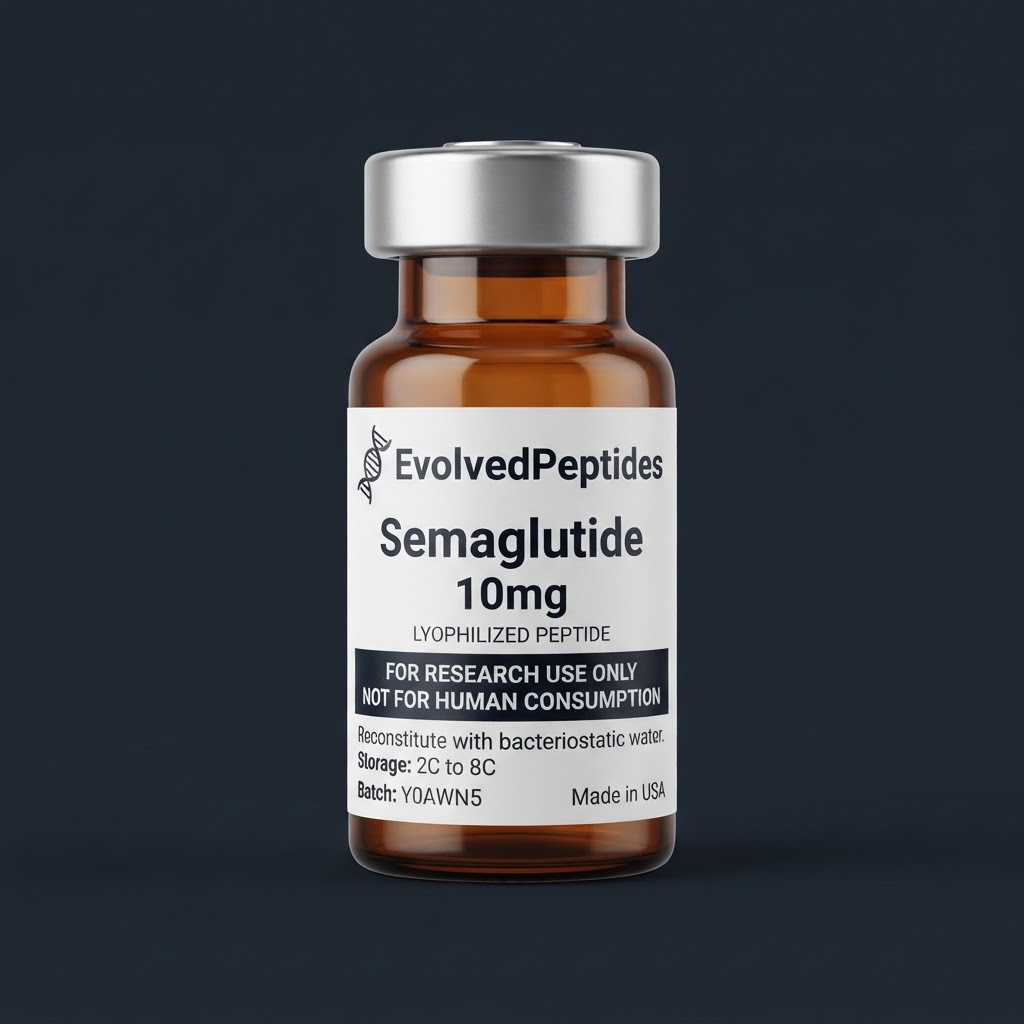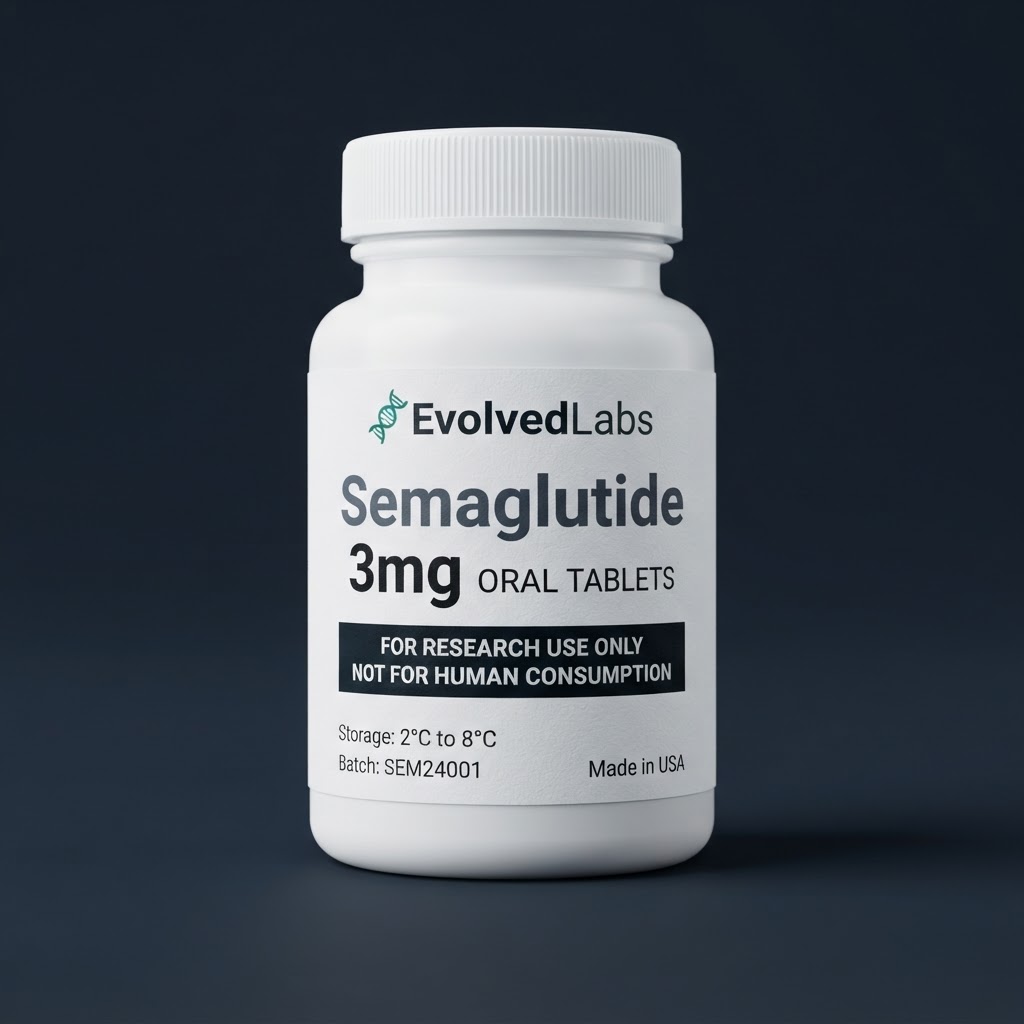
Oral Semaglutide Tablets: GLP-1 Receptor Agonist Research Overview
Oral semaglutide tablet formulations deliver the GLP-1 receptor agonist by an oral route, a formulation of major interest in metabolic and weight-management research. Explore absorption science, research protocols, and how oral delivery compares to injection.
Semaglutide is a long-acting glucagon-like peptide-1 (GLP-1) receptor agonist originally developed as a once-weekly subcutaneous injection. The development of an oral tablet formulation of semaglutide marked a milestone in incretin research: GLP-1 peptides are normally far too large and fragile to survive the digestive tract, and oral delivery required a novel absorption-enhancing technology. For researchers, oral semaglutide tablets provide a convenient reference material for studying the GLP-1 receptor system by a non-injectable route.
What Is Semaglutide?
Semaglutide is a 31-amino-acid modified GLP-1 analogue with:
- Aib substitution at position 8: Resists dipeptidyl peptidase-4 (DPP-4) degradation - C18 fatty diacid at Lys26: Promotes albumin binding, extending half-life to approximately one week (165 hours in pharmacokinetic research) - 94% sequence homology to native human GLP-1
The Oral Absorption Challenge — and Solution
Native GLP-1 has a half-life of roughly 2 minutes; even engineered analogues are poorly absorbed orally because peptides are degraded by gastric enzymes and cross intestinal epithelium inefficiently. The oral semaglutide research formulation overcame this with:
1. SNAC (sodium N-[8-(2-hydroxybenzoyl)amino]caprylate): An absorption enhancer co-formulated with the peptide 2. Localized pH modulation: SNAC transiently raises local gastric pH, protecting semaglutide from enzymatic degradation in the stomach 3. Transcellular absorption: Promotes semaglutide passage across gastric epithelial cells via lipophilic interactions 4. Fast gastric emptying effect: The formulation is designed to work during a limited absorption window in the stomach
Even with this technology, research reports oral bioavailability of roughly 0.4-1% — a remarkable achievement for a peptide, but still requiring higher nominal doses than the injectable route to achieve comparable systemic exposure.
GLP-1 Receptor Mechanisms
Once absorbed, semaglutide activates GLP-1 receptors with the same pharmacology regardless of route:
- Pancreatic beta cells: Enhances glucose-dependent insulin secretion - Alpha cells: Suppresses glucagon release - Central nervous system (hypothalamus, brainstem): GLP-1 receptors in appetite-regulating nuclei reduce hunger signaling and increase satiety — the basis of the compound's weight-management research profile - Gastric emptying: Slows gastric emptying, contributing to post-meal glycemic control - Cardiovascular tissues: GLP-1 receptor activation on vascular endothelium is studied for cardiometabolic effects
Research Findings
Clinical research on oral semaglutide has reported:
- Significant dose-dependent reductions in HbA1c and fasting glucose in type 2 diabetes trials - Dose-dependent body weight reduction in obesity research — with higher oral doses producing weight changes approaching those of injectable semaglutide - Food intake reductions in appetite and eating-behavior studies - Favorable tolerability profile, with the most commonly reported research observations being transient gastrointestinal effects during dose escalation
Standard Research Protocol Reference
| Parameter | Typical Research Reference | |---|---| | Dose | 3 mg per tablet (50-count oral formulation) | | Frequency | Once daily | | Route | Oral | | Escalation | Gradual titration referenced in published protocols | | Monitoring markers | Body composition, glucose tolerance, appetite markers, lipid panel |
Published protocols reference gradual dose escalation over 4-week intervals to improve tolerability in research subjects.
Oral vs. Injectable Semaglutide in Research Settings
| Property | Oral tablets | Subcutaneous injection | |---|---|---| | Frequency | Daily | Weekly | | Bioavailability | ~0.4-1% | ~89% | | Peak exposure | 1 hour | 1-3 days (plateau) | | Dose required | Higher nominal dose | Lower dose | | Administration complexity | Simple | Requires reconstitution/injection | | Research context | Convenience, adherence modeling, oral-route studies | Maximum-exposure studies, tight control |
For laboratory research, the tablet formulation offers precise per-unit dosing (3 mg semaglutide per tablet) and eliminates reconstitution variables — useful for studies where injection logistics complicate protocols.
Storage and Handling
Research-grade oral semaglutide tablets should be stored at controlled room temperature, protected from moisture, and handled with standard laboratory safety protocols.
*This article is for research and informational purposes only. Oral semaglutide is sold for laboratory research purposes only and is not intended for human consumption. Not evaluated by the FDA.*