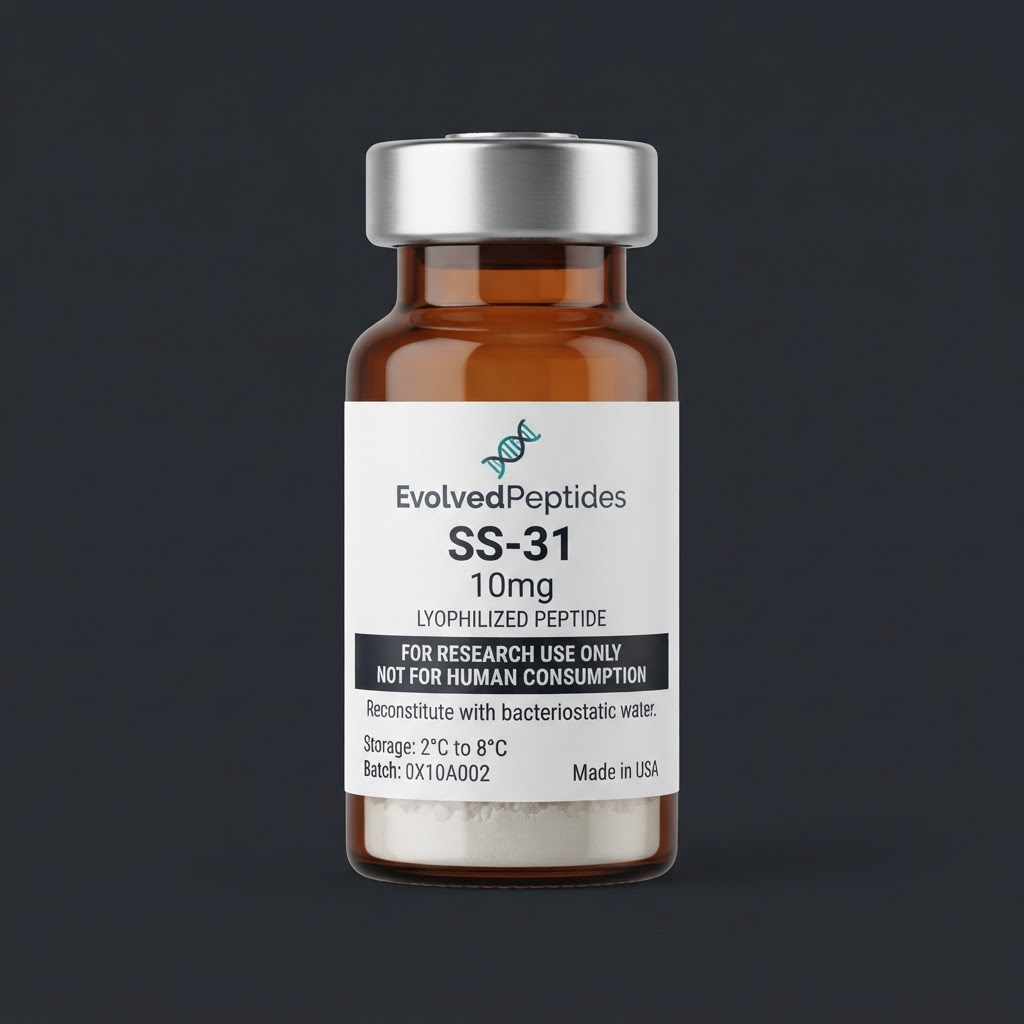
SS-31 (Elamipretide): Mitochondria-Targeted Peptide Research Overview
SS-31 (elamipretide) is a mitochondria-targeted tetrapeptide studied for its effects on mitochondrial membrane potential, oxidative stress, and energy production in research models. Explore its mechanisms and research applications.
SS-31, also known as elamipretide or Bendavia, is a synthetic tetrapeptide (D-Arg-Dmt-Lys-Phe-NH2) belonging to the Szeto-Schiller family of aromatic-cationic peptides. It is one of the most studied mitochondria-targeted compounds in biomedical research, investigated for its ability to concentrate in the inner mitochondrial membrane and modulate mitochondrial function in disease and aging research models.
Why Mitochondria Matter in Research
Mitochondria generate most of the cell's ATP via oxidative phosphorylation, but they are also a major source of reactive oxygen species (ROS). Mitochondrial dysfunction — loss of membrane potential, cardiolipin oxidation, impaired electron transport chain efficiency — is implicated in a broad range of research contexts: ischemia-reperfusion injury, heart failure, kidney disease, age-related macular degeneration, and skeletal muscle aging.
Structure and Mitochondrial Targeting
SS-31 is deliberately small (four amino acids) and unusual in composition:
- Aromatic-cationic design: Alternating cationic and aromatic residues allow the peptide to freely cross cell membranes without transporters - Cardiolipin binding: SS-31 concentrates ~1,000- to 5,000-fold in the inner mitochondrial membrane by binding cardiolipin — a phospholipid unique to mitochondria - D-amino acids: The D-Arg residue improves resistance to proteolytic degradation
Mechanism of Action
Research models suggest SS-31 works through several linked mechanisms:
1. Cardiolipin stabilization: SS-31 binds oxidized cardiolipin and stabilizes the interactions between cardiolipin and electron transport chain complexes, improving the efficiency of electron flow 2. Reduced ROS production: By improving electron transport chain organization, SS-31 reduces electron leak and superoxide generation at Complexes I and III 3. Membrane potential preservation: SS-31 helps maintain mitochondrial membrane potential under stress conditions such as ischemia-reperfusion 4. Reduced apoptosis signaling: Cardiolipin oxidation normally triggers cytochrome c release and apoptotic cascades; stabilizing cardiolipin attenuates this pathway in research models 5. Mitochondrial dynamics: Some studies report improved fission/fusion balance and mitophagy markers
Research Applications
SS-31 has been studied across an unusually broad range of models:
- Ischemia-reperfusion: Extensively studied in cardiac and renal ischemia-reperfusion models, where it is typically administered around the reperfusion event and reduces infarct size and ROS markers - Heart failure research: Chronic SS-31 administration improved mitochondrial respiration and diastolic function in aged and failing-heart animal models - Kidney disease: Studied in models of acute kidney injury and mitochondrial nephropathy - Skeletal muscle aging: Aged-mouse studies reported improved mitochondrial energetics, exercise capacity, and fatigue resistance - Ophthalmic research: Investigated in age-related macular degeneration and Leber hereditary optic neuropathy trials at the clinical research level
Standard Research Protocol Reference
| Parameter | Typical Research Reference | |---|---| | Dose | 1-2 mg per administration | | Frequency | Once daily | | Route | Subcutaneous injection | | Duration | Continuous or cycle-matched to study design | | Monitoring markers | Mitochondrial membrane potential, ROS markers, ATP output, exercise capacity |
Common research references cite 1-2 mg daily via subcutaneous administration in rodent and cell research protocols, scaled by model.
SS-31 vs. Other Mitochondrial Peptides
| Property | SS-31 (Elamipretide) | MOTS-c | |---|---|---| | Class | Szeto-Schiller aromatic-cationic peptide | Mitochondrial-derived peptide (hormone-like) | | Primary target | Inner membrane cardiolipin | Nuclear gene expression / AMPK signaling | | Best-studied context | Ischemia-reperfusion, cardiac energetics | Exercise and metabolic research | | Administration | Subcutaneous | Subcutaneous |
Quality Considerations for Research Material
When sourcing SS-31 for laboratory research, verify: - HPLC purity verification (≥98%) - Certificate of Analysis with sequence and mass confirmation - Batch-specific documentation - Appropriate storage: lyophilized, refrigerated until reconstitution
*This article is for research and informational purposes only. SS-31 is sold for laboratory research purposes only and is not intended for human consumption. Not evaluated by the FDA.*