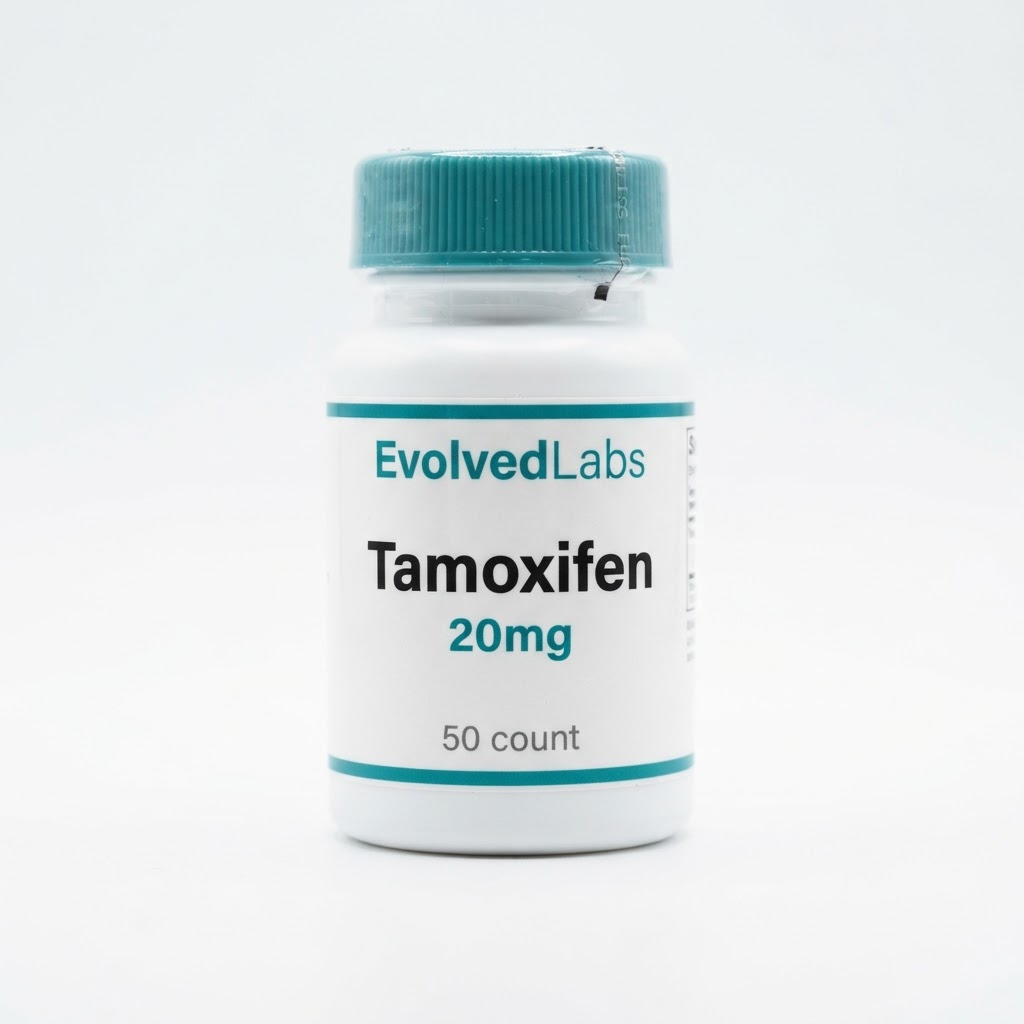
Tamoxifen: SERM Research and Estrogen Receptor Modulation
Tamoxifen is one of the most studied selective estrogen receptor modulators (SERMs) in oncology and endocrinology research. Explore its tissue-selective mechanisms and research applications.
Tamoxifen is a selective estrogen receptor modulator (SERM) — a class of compounds that act as estrogen receptor agonists in some tissues and antagonists in others. It is one of the most extensively studied compounds in oncology and endocrine research, with decades of clinical and preclinical literature.
What Is a SERM?
Selective Estrogen Receptor Modulators (SERMs) are compounds that bind estrogen receptors (ER) but produce tissue-selective effects:
- Antagonist in some tissues (blocking estrogen's effects) - Agonist in other tissues (mimicking estrogen's effects) - Mixed/Partial agonist in yet other tissues
This tissue selectivity occurs because: 1. Different tissues express different ER subtypes (ERα vs. ERβ) 2. Different tissues express different co-regulator proteins (co-activators and co-repressors) 3. SERMs induce different ER conformations, leading to different co-regulator recruitment
Tamoxifen's Tissue-Selective Profile
| Tissue | Tamoxifen Effect | Significance | |---|---|---| | Breast | Antagonist | Blocks estrogen-driven proliferation — basis of breast cancer research | | Bone | Agonist | Maintains bone density (estrogen-protective effect preserved) | | Liver | Agonist | Maintains favorable lipid effects (lower total cholesterol, LDL) | | Uterus | Partial agonist | Can stimulate endometrial proliferation | | Cardiovascular | Agonist (beneficial) | Favorable lipid profile effects |
Mechanism of Action
1. ER binding: Tamoxifen binds estrogen receptors (primarily ERα) competitively, blocking estradiol binding 2. Conformational change: The tamoxifen-ER complex adopts a different conformation than the estradiol-ER complex 3. Co-regulator recruitment: The altered conformation recruits different co-regulators depending on tissue: - In breast tissue: Recruits co-repressors → blocks estrogen-driven gene transcription - In bone/liver: Recruits co-activators → maintains estrogen-protective effects 4. Anti-proliferative effect in breast: Reduces estrogen-dependent cell proliferation
Pharmacokinetics
- Route: Oral - Half-life: 5–7 days (enables once or twice daily dosing) - Active metabolite: Endoxifen (4-hydroxy-tamoxifen) — significantly more potent than parent compound - Metabolism: Extensive hepatic metabolism via CYP450 enzymes (CYP2D6 is critical for endoxifen formation) - Steady state: 4–6 weeks
Research Applications
1. Breast Cancer Research Tamoxifen is one of the most studied compounds in breast cancer research: - ER-positive breast cancer treatment and prevention models - Adjuvant therapy research (post-surgical prevention of recurrence) - Chemoprevention in high-risk populations - Research spans decades with extensive outcome data
Key research findings: - Significant reduction in ER-positive breast cancer recurrence - Risk reduction in contralateral breast cancer - Chemopreventive effects in high-risk populations - Long-term benefits extending beyond treatment period
2. Estrogen Management in Hormone Research Tamoxifen is used in hormone research protocols to: - Block estrogenic effects while maintaining androgenic activity - Prevent/managing gynecomastia in androgen research - Study isolated androgen effects without estrogen confounding - Manage estrogen-related side effects in TRT/AAS research models
3. Bone Metabolism Research As an ER agonist in bone, tamoxifen: - Maintains bone mineral density (unlike aromatase inhibitors) - Protects against post-menopausal bone loss - Studied in osteoporosis prevention models
4. Cardiovascular/Lipid Research Tamoxifen's ER agonist activity in the liver produces: - Favorable lipid changes (reduced total cholesterol, LDL) - Cardiovascular risk marker improvements - Studied in cardiovascular risk research
Tamoxifen vs. Aromatase Inhibitors
| Property | Tamoxifen (SERM) | Anastrozole (AI) | |---|---|---| | Mechanism | ER antagonist in breast | Blocks estrogen production | | Estrogen levels | Preserved | Dramatically reduced | | Bone effects | Protective (agonist) | Negative (bone loss risk) | | Lipid effects | Favorable | Neutral or negative | | Uterine effects | Stimulatory (risk) | None | | Research context | Breast preservation, hormone management | Maximum estrogen suppression |
The choice between SERMs and AIs in research depends on the specific research question — whether estrogen preservation (bone, cardiovascular) or maximum estrogen suppression is the priority.
Standard Research Protocols
Breast Cancer Research: - Dose: 20mg daily - Route: Oral - Duration: 5–10 years in long-term studies - Monitoring: Estrogen receptor status, proliferation markers, bone density, endometrial screening
Hormone Management Research: - Dose: 10–20mg daily - Route: Oral - Timing: Based on research protocol design - Duration: Varies — cycled or continuous depending on protocol
Safety Considerations in Research
Endometrial Effects: Tamoxifen's partial agonist activity in the uterus can stimulate endometrial proliferation: - Research protocols monitor endometrial thickness - Endometrial effects are dose and duration dependent - This is the most significant consideration in long-term tamoxifen research
Thromboembolic Risk: Tamoxifen carries a research-documented risk of venous thromboembolism: - Research protocols consider thromboembolic risk factors - Particularly relevant in immobile or high-risk research subjects
CYP2D6 Metabolism: Endoxifen (the active metabolite) formation depends on CYP2D6: - CYP2D6 polymorphisms affect tamoxifen metabolism - Some research protocols genotype subjects for CYP2D6 status - CYP2D6 inhibitors may reduce tamoxifen efficacy
Ocular Effects: Long-term tamoxifen research monitors for: - Retinal changes - Corneal changes - Visual disturbances
Hot Flashes: The anti-estrogenic effect in the hypothalamus commonly produces vasomotor symptoms (hot flashes) — an expected pharmacological effect.
*This article is for research and informational purposes only. Tamoxifen is sold for laboratory research purposes only and is not intended for human consumption. Not evaluated by the FDA.*